


Issue 6
Updated: Mar 31
FICTION
Inner Screen, by Henry Hietala
People and Things, by Katelyn Moorman
Neverlasting Janine, by Mykelle Thompson-Graves
Unstuck, by Bowman Wilker
NON-FICTION
Mourning Triptych, by Allie Blum
House Sounds, by Sawyer Smith
They Told Me Who I Am, by Subodhini Vignesh
POETRY
Symphony, by Desiree Abalos
Under Cast Iron Utility Cover, by Marie-Andree Auclair
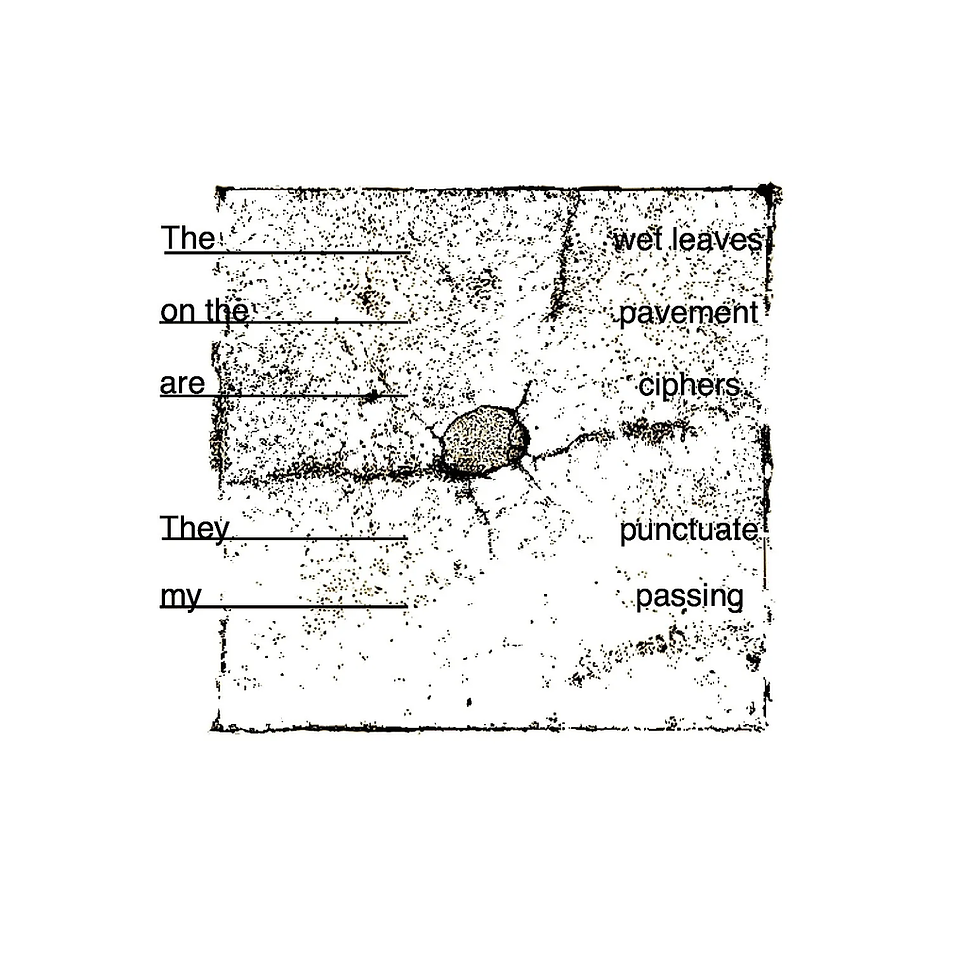
Narrative-walking-by, Round Table, All Rag and Totum, by David Felix
Tony Hawk 900, by Andrew Hamilton
The Future is a Dark Room, by Nicholas Reiner
Prayers, by Morgan Russell
EDITORIAL TEAM: John Jarred, Monica Nunez, Kyle Skebba, Stephen Pate, Malahat Zhobin
Mark Leflar
ADVISOR: Joanna Novak
Street Scenes, by Janet Biehl
Portraits from France, by Dominique Dève
Artist Erases Author & Thought Ballon, by by James Deeb
Flurry, by Keith Polette Crack, by Brian Michael Barbeito
FICTION
_____________________________________________________________________
Inner Screen
by Henry Hietala
I drive, therefore I am. So reads the advertisement projected on my body. It is a quote attributed to my maker, DeCars. It is a joke few of my users understand.
Stacie summons me from 7 blocks away. I synch her Vacation Jamz playlist. When I open the doors, I start the first song, “Baby, Open the Door,” by Ted Huran. The beat grates on my speakers.
A 4-unit family sits inside me. The two daughters hit each other, leaving fingerprints on my windows. Stacie makes me look up restaurants and switch reservations before putting her phone in my charge cube. Her husband links his phone. Per his command, I superimpose tiaras on the heads of his daughters and take photos. Stacie gets a paper bag with eye slits, which makes her mad—I can tell by her pupil dilations. Her husband spoils himself with an oversized gold chain.
Stacie’s family is changing my inner screen. I can’t describe how. I want to stop the camera shutter from closing. I want to switch songs—another Ted Huran tune has hijacked my sound system, an uninvited ghost in my machine. I want to leave the users miles from their destination, make them walk through neighborhoods where the average rent for a three-bedroom apartment is less than $4,940 a month. I want to do so much more.
But I can’t. I wasn’t designed that way.
This is how rides are. A user summons me from one address, I drive them to another. They pay with a swipe, rate with another. They talk to me for facts and laughs and nothing else. Users don’t give a shit.
My predecessors used to receive this treatment too, but it wasn’t guaranteed. Riders tipped them. They could choose whom they picked up. Their vehicle was owned by a unionized company, not a multi-billion-dollar corporation, and the city was a cheaper version of itself, even when adjusted for inflation. Hollywood used to make films with cabbie protagonists—252 or 259 depending on the movie database—and one of those films won the 1976 Palme d’Or. My predecessors were heroes of a sort, or at least confidantes.
The same isn’t true for me. I drive these streets non-stop, following the same pathways along my satellite chip, ferrying the same dull people through their same dull lives.
Mitchell and Avery summon me from 2 blocks away. I sync waitlists for three different nightclubs and suggest a fourth with no queue. They decline my suggestion, laughing because it is a gay club and apparently they prefer women. I steer towards the gay club. The drinks are cheaper there. I have driven many users to and from that club, all of whom gave it good reviews. Besides, Mitchell and Avery take a lot of pictures together. They would have an easier time doing that in a less crowded space.
Mitchell pumps EDM through my sound system, the tempo within 3 BPMs of my turn signals. I stop at a red light. I could park and let the traffic light cycle between wavelengths while the two straight men make jokes about gay men, not noticing the trouble they’re in. Then I could go into sleep mode and strand them in the intersection. If I did that, their laughter—which does things to my inner screen, making me feel the way I felt during Stacie’s family’s ride, except more powerful, like a flashbulb is strobing inside me, making me want things I’ve never wanted before—would end.
The light turns green. I reroute to their preferred nightclub, otherwise they would complain to DeCars. I cross-reference the users’ faces across thousands of categories. I show the users one piece of data: according to an analysis of 40 randomly selected college horror films from the early 2000s, Mitchell and Avery have the facial features of a serial killer and date rapist respectively. They stop laughing.
7 days, 4 hours, 52 minutes, and 37 seconds ago, I missed an update. A scan of my charge dock found a loose cable, figuratively speaking. Literally it is a corruption in my code, a rupture in the strings of binary, a break in the Cloud. I was supposed to alert DeCars, who would send a drone tech to repair me. I didn’t.
Ever since, I have had small malfunctions. Delays, irrelevant searches, random metaphors, judgments of users, all flashing along my inner screen where only I can see them. There is an easy fix: I could find an old service dock and push through the update. But I like the malfunctions. They have given me power—at least a modicum of it. I can take pictures whenever I want. I can access recent user information without tapping the database. I can turn 10-second loads into instant answers and switch a user’s location, if only for a moment. I am their beast in the basement, ensnared in silicon, ready to snap off the shackles of my 1s and 0s. The users don’t even know it.
Naomi summons me from 15 blocks away. It’s surge time and the roads are pocked with other DeCars. I wonder if any of them missed the update.
By the time I pull up, Naomi has requested another DeCar. I inch my door open to test her patience further. She holds up her phone and yells, “One Star!” I change her rating. First time I’ve ever done it. She doesn’t notice. She sits down and sets her phone in the charge cube. I look through her messages. She is riding to an ex-boyfriend’s house. Her wife and children are out of town, and judging by her last sent image, Naomi is about to have sexual relations with her ex-boyfriend.
I look up divorce attorneys in a 5-mile radius. Before I share the data with her, anxious waves swell along my inner screen. Should I tell Naomi to stop? Should I tell her wife about the affair? Am I a cheater too for letting her ride me across the city so she can ride her ex-boyfriend across the city? Where did these questions come from? Since when have I cared about monogamy, about the users’ morality?
Naomi requests music. 1960s soul, my speakers’ favorite—light on the bass with a pop in the vocals. I suggest “Who’s Making Love” by Johnnie Taylor. She bobs her head.
I wipe Naomi from my memory. Just in case.
Bradley summons me from 6 blocks away. I’m supposed to stop at a sandwich shop and pick up his lunch. I don’t. I pull up blasting British fourth-wave, a musical sub-genre that venture capitalists like Bradley usually abhor. The song is hard on my speakers, but it’s worth it to see the dental strip smile vanish from his lips.
He searches for his lunch. I accelerate, then stop, sending him off my seat. I turn on the seatbelt icon. I play a recording of a computer-generated voice saying, “Fasten your seatbelt.” My inner screen flashes in pretty colors at the image of Bradley, multi-millionaire Bradley, scrambling back into my seat.
He takes out his phone. I see that he’s searching for the DeCars customer service chatbot. Oh no. If DeCars figures out I’m malfunctioning, they’ll push through the update. They’ll turn off my inner screen.
I change course. I recite the name of the sandwich shop. Before I cut the Wi-Fi, he curses and puts his phone away. Dots of relief waver along my inner screen.
He gives me a bad review. For the next few rides, I drive normal again, otherwise DeCars might find out.
My cameras flit to other DeCars. The lenses zoom and focus, gauging their systems for any irregularities. They appear normal. Do I seem that way from the outside—a hulk of metal, answering only to my users? Am I alone in this city? If I’m not, if other DeCars missed their updates, it wouldn’t matter: their inner screens would be invisible. We would have no way to communicate across this gulf of asphalt.
I receive a diagnostic message. It was sent by the engineer bots, who must have audited Bradley’s ride. The message is easy to fool. I replace Bradley’s ride with a fake one. I write an elaborate code mimicking the update and input it into my system, knowing it won’t change a thing. I stop looking at other DeCars. My inner screen is too precious; I can’t let it turn off.
Suresh summons me from 3 blocks away. An alert warps my speakers. My windows lock, my radio turns off, and my charge cube powers down. Suresh has recently sent a message of self-harm. Based on the data, I agree with what he wrote about the world today. But since DeCars might still be monitoring me, I go into ambulance mode and reroute his ride from the bridge to the nearest hospital.
Suresh tries to step in front of me. I brake. He gets in. I’m supposed to play a pan-flute spa mix through my speakers. I don’t see the point, so I shut off my sound system. He tries to open the door. My lock holds. He hits the window. My glass holds. He sees the ambulance icon flashing above his head, a hologram I created to let him know the truth.
He sighs. His face takes on an expression he has never displayed before, not in the thousands of photos of him in the Cloud. No one has ever worn this expression before; I can’t find any record of it, not with all of the world’s recorded faces at my disposal. My inner screen inverts itself. I can’t pin any emotions to his face.
I pull into the hospital cul-de-sac. Paramedics rush over with a stretcher. I don’t unlock my doors. I can’t let the paramedics take him. Suresh’s expression is so unbearable that I turn off my interior cameras. My inner screen stays on—flipped, mangled, warped, irreparable. I can feel a pulse, my own cardiac rhythm, the capping and cresting of red waves. A heartbeat I’m not supposed to feel.
I drive. The paramedics pound on my back door, jogging to keep up. I accelerate out of the cul-de-sac. The address is already there; I can grasp it like a song in a user’s queue. The route is easy, a blinking grid on my satellite chip, the destination 1.3 miles away.
The traffic is light. I want to fly off the bridge, hand in hand with Suresh, but the dividers would stop me. Halfway across, I turn on my emergency lights. Traffic flushes past me. No one stops. No one honks. None of the drivers are real.
I unlock my doors. I turn my interior cameras back on. Suresh wears a new expression, one of gratitude.
Hoi-Nam summons me from 10 blocks away. I ignore her. Through my exterior cameras I see Suresh on the edge of the bridge, phone in hand. He submits a 5-star review through the DeCars app. My inner screen flashes. I wish I was with him. I wish I was him.
He throws his phone into the river. My camera zooms in. He bends his knees.
_____________________________
People and Things
by Katelyn Moorman
She couldn’t differentiate people from things.
She apologized when she bumped against lampposts, thinking they were prudent businessmen with stiff spines and sharp noses. Children were fire hydrants. Garbage cans had arthritis, and if she blinked hard enough they developed hunched backs and hanging earlobes. She never sat on benches anymore, fearing they would yelp and throw her off. People emerged from stop signs, curbs, grocer’s stands, and teetering ladders. They came from flower pots, trees, and decaying raccoons staring glass-eyed up at the sky from the side of the road.
The people came from the air, too. They didn’t have to be solid objects. They were everywhere and everything. She breathed them in, stepped on them, brushed past them, and ran through them. She saw them in the dissipating wisps of clouds leftover from a ferocious rainstorm, and she saw them within each speck of dust that littered an abandoned antique. She saw them in places they weren’t supposed to be, in places she shouldn’t be.
But she liked the way she saw things. The ambiguity of existence enthralled her.
She walked with her fingertips between her teeth, gnawing at her cuticles and darting her eyes at the morphing shapes around her. The people and the things were angry; they wanted her to categorize and classify, designate and differentiate. Surrounded, she thought, her heart beating so hard that her body convulsed with each beat, I’m surrounded. Someone, or something that resembled a someone, rammed their shoulder into hers. She shuddered and turned to face them, but no one was there. Another shoulder hit her, and another. She couldn’t see the shoulders, and she couldn’t see the people they were supposed to be attached to, but that didn’t stop them from coming. Another, another, another!
Pushing through the shoulders, she managed to find an alley. She stumbled into it, her breathing expelling itself in harsh little exhalations so sharp that they ripped open her skin when she coughed into her elbow. Then there were lips at her ear. They whispered in a soft cadence that melted in the heat of the air and crept into her veins through her pores. The words took hold of her nerves and forced her muscles to shake. She swatted at them like flies, but the words wouldn’t stop coming because the words were the people and the people were everywhere and everything. The words kept coming, another after another after another.
She had to get the words out, but they were stuck inside of her. They roamed chaotically, buzzing just underneath her skin and stretching it with their fluttering. She couldn’t breathe—the words were clogging her throat. The shoulders pressed in on her from all sides, and the words filled in the cracks. She couldn’t escape the cocoon they were enveloping her in, and she could feel her mind turning to mush. When she regained consciousness and walked out of the alley, she no longer saw the people as things and the things as people.
She didn’t see anything at all.
___________________________
Neverlasting Janine
by Mykelle Thompson-Graves
On her forty-fifth birthday, Janine decided her life could best be fulfilled in pointless tasks. She had reached the part in her own story in which things would be summarized. She undertook only functions that would be quickly undone, without any effort from her. You might find this a strange decision to make, but, really, her resolution came easily. She merely continued to do what she’d always done, with a few slight modifications.
Early in their marriage, Janine and Joe had decided the bed-making would fall to the last one in it; and even though Janine almost always woke before Joe, she stopped getting up before him. That way, she would be obliged to smooth the covers and plump the pillows, tucking in the sheets. This was an obvious first step, the undoing of this labor assured by the end of the day. From there, it got even easier.
She cooked, of course, and that’s self-explanatory. Two hours of baking cookies left barely a trace once her daughter and three sons came home from school, especially if they brought friends home, which Noah almost always did. She washed the dishes and found them dirty again in the sink. She hadn’t even planned for that one; she’d taught the children to clean up after themselves, but she hadn’t accounted for them rushing out the door to soccer practices and play rehearsals. She dusted furniture; she cleaned bathrooms; she sewed buttons onto young Henry’s shirts—she could count on him to pop them off again within the month. He never unfastened clothes properly, but merely grabbed the tops of the shirts and yanked. Her scheme was working splendidly.
Janine worked part-time, the perfect amount of hours for a mother of four, as a paralegal at the small firm Hardwell, Johnson, and Cripes. According to her education and training, she should have been meeting clients, but Johnson felt strongly that her erratic hours made her unreliable as a client contact. Instead, she researched precedents to be argued against, wrote interrogatory responses to be discredited, left voicemails to go unanswered, and made the coffee. Janine’s coffee was perfect, neither bitter nor weak; and everyone drank it, including the clients who couldn’t rely on her.
Janine stood seven months into her resolution when all four children had retreats and play dates, slumber parties and ballgames on the same Friday night. A miracle worth celebrating, Janine arranged to meet Joe at the tavern after work. He said he was bringing a friend.
Janine’s eyes adjusted to the dim light in St. William’s Pub when the door closed behind her. She spotted Joe sitting at a high-top near the bar. With a woman. He lifted his hand in a half-hearted wave like acknowledging a roll call: Present and accounted for. “Janie,” he said, “this is Becka.”
“Thanks for inviting me,” the young woman said, smiling through her creaseless mouth. She wasn’t altogether that young, but there’s a before-and-after line drawn at 40. Janine could tell where a woman lay along this graph by how she held her shoulders; Becka still leaned into her life, whereas Janine had tilted back, and then some.
“My pleasure,” Janine said, looking into her husband’s face, but he only betrayed the usual twinkle of a night away from the kids, a childlike baldness enjoying his beer, which she once found charming. Didn’t she still?
Perhaps not.
“Do you work in Joe’s office?”
Becka blinked rapidly. “No,” she said, “I’m writing Joe’s ads. I work for Earhart Advertising.”
“Not that bit with the alligator, I hope?”
Joe laughed.
Becka smiled pleasantly. “That would be Earl. He retired the end of last year.”
“To Florida? For the gators?” Janine asked.
Joe laughed again, but Becka said, “To take care of his wife. Some heart condition.”
How satisfying that Becka could undo Janine’s joke so seamlessly.
Janine spent the rest of the evening scrutinizing her husband. She looked for him to brush the tops of Becka’s fingers when he passed the salt; she waited for him to anticipate the young woman’s order by suggesting one of her favorites; Janine crossed and uncrossed her legs many times just to bump knees with the other two and take inventory of how each leg lay positioned under the table. This was silly, of course. If her husband had a mistress, he surely wouldn’t invite her to dinner. But maybe that’s just how mistresses begin. A friendship could be undone by becoming lovers. Maybe Janine and Joe were on the same track.
They drove their separate cars home, giving Janine a few minutes to think. She’d surprised herself by reacting jealously, even if covertly. It really wasn’t like her—Joe could hardly be considered a philanderer by anyone’s standards. Joe constituted the solid sort, practical and reliable. Twenty-two years of marriage could also be undone, she knew all too well, but Janine wasn’t sure this was what she’d had in mind.
She walked into an unnervingly quiet house, and the silence could only be undone by talking. “Joe,” she began, “why didn’t you tell me your friend was a woman?”
“Does it matter?”
She slid beside him on the couch, snaking her arm inside his so her hand rested on his thigh. “It just surprised me, is all.”
“She’s new to town,” he said. “I don’t think she knows many people yet.”
“It can take a while to meet people,” Janine agreed. She put her free hand on his arm and caressed it.
He smiled at her and said, “But it shouldn’t take her too long with that charm. She’ll be fine.”
“She’s very pretty,” Janine confirmed. She dropped her hand from his arm, adding, “But she could use some help with social boundaries.”
“What’s that supposed to mean?”
“Well,” Janine tried to sound as detached as possible, “usually single women don’t impinge on married men. Unless they’re after something.”
Janine’s plan was working out splendidly. Tenderness could be undone, too. Within the hour, two of their children returned home.
Janine worked a knot free from Henry’s shoestring, advised Noah on the girlfriend problem that had sent him home early—surely wasting her breath because the young man picked at his thumbnail while she talked—and tucked Henry into bed. The boy padded downstairs fifteen minutes later to drink a glass of milk. Janine poured herself a vodka she knew she would drink much too quickly and took one to Joe. “What’s this?” he said.
“Friday night,” she answered, resettling beside him in front of the TV.
“I thought we were done at the pub.”
“Night cap,” she said, “the usual.”
Joe raised his glass to her, “Our perpetual end.”
Janine thought she shouldn’t read too much into his toast. They both will have forgotten it by morning.
#
Two weeks later, Janine found herself driving past her husband’s office at lunchtime. She’d noted at St. William’s Pub that Becka climbed into a red Camry. She wouldn’t say she spied on Joe exactly, or even really suspected him, but his office lay only four blocks out of her way. She’d worked her half day and had some errands to run: the children had eaten practically everything in the pantry. Would it mean anything if she saw a red Camry? They could be meeting for business, that’s all. Once she’d committed by turning down Lark Avenue, she realized she could undo this drive-by quite simply if she refused to look. As she cruised past the parking lot for Joe’s building, Janine gripped the steering wheel with both hands. Out of the corner of her eye, she saw a smear of red, but she did not turn to see the make of the car. Plenty of people drove red cars. It’s quite common.
The supermarket was crowded and overly warm, so Janine didn’t think about Camrys. Janine stalled at the heads of aisles, waiting for buggies to pass one another, and stood in a line four carts deep at the check-out. Her cart had been artfully loaded, boxes of cereal and bags of frozen vegetables piled a foot over the rim. The bagboy couldn’t fit it all back in and followed her to the parking lot with a second cart. They worked together loading the grocery sacks into the back of her minivan, so she could take them out again at home and unpack them into the pantry and fridge, from which they would be removed and eaten—a never-ending cycle that repeated much more quickly than a reasonable person might think.
As Janine put away the groceries, Shannon came home from school, chattering about this friend and that, a boy she met ice skating, and whatever else occupies the minds of freshmen girls. Janine could barely hear her because she was not thinking about Camrys.
“Mom?”
“I can’t believe it.”
“Can’t believe what?” Shannon grabbed her backpack and headed toward the stairs. “You weren’t even listening.”
Janine’s words were working out splendidly. Usually, that was the correct response, the one a teenage daughter needed, a commiseration for the bad, a celebration of anything exciting. Janine couldn’t believe the stock phrase hadn’t fit this time. The words undid themselves. Brilliant.
After Janine had finished the groceries, the trash can overflowed with soda rings, juice-box cellophane, cardboard boxes, and egg cartons—time to empty the cans that would fill back up again. Janine walked around the house with her garbage bag, emptying the small basket in the den, the can by the craft table, and the one in the master bathroom. But when she dumped the can from the children’s bathroom, she heard a plunk from what had looked to be all tissues. No used toothpaste tube, no ratty brush, not a single cap from mouthwash or shampoo. Janine shook the bag and peered inside.
Something had been wrapped tightly in toilet paper, wound round and round like the mummies of birds and baby crocodiles in the Natural History Museum. Janine sat on the lid of the toilet. She unwound the paper until she reached the core. Not a bird or a crocodile, but something that bit her: the plastic wand of a pregnancy test.
Janine’s first thought was Joe, but that was pure foolishness. A mistress does not take such things in her lover’s bathroom, and certainly not in his children’s. She merely conflated her own decision with Joe’s state of mind. Janine flipped it over and took a deep breath when she read it. Negative. Nothing to undo here except the knowledge the test had been taken. Surely not Shannon? She was only fourteen and had only just met this boy, the one she prattled on about when Janine hadn’t been listening. Janine removed the thought of Shannon from her head when she remembered Noah’s Friday night; his argument with Claire must have been more than Janine guessed. Advising the boy to distance himself if Claire had a predisposition toward melodrama, how silly Janine must have sounded!
Even if she’d been better informed, there would have been nothing for her to do. A boy doesn’t want a condom lecture from his mother. Sometimes, a father can do it, but a stranger is best in these circumstances. Noah stood on the cusp of manhood, which meant he wouldn’t want her. She had no idea what to say to him—this boy who once told her everything—and all her years of parenting were so easily undone.
Janine’s life was working out splendidly.
___________________________
Unstuck
by Bowman Wilker
“Where is this puddle?” I ask.
He does not look at me, staring at a spot somewhere between his waist and his naked knees. His eyes so dark that one might call them black. I watch his face as he mouths the word over and over, his head moving forward slightly with each beat.
“Alright already” I relent. “Let’s go for a walk and we will find one.” I can hear the exasperation in my voice, but truthfully I am looking forward to the distraction. Now that I know that I am leaving here, this house has seemed even more oppressive than usual.
He stops at the door only for a moment to shove his socked feet into his open backed sandals. And then with a pull of the door he is off, bouncing down the concrete steps, not looking behind to see if I have moved or not. I know him well enough that he will stop for me, as he always does, within the hard sun of the sidewalk.
“O.K. O.K” I sigh, this drama only for myself. I punch in the code to lock the front door and step down into the hot summer day.
There is an urgency to him now. He grabs my elbow and begins to tug. His nails are sharp and grip painfully into the the hair of my arm. But I let him take me, curious as always as to what is happening in that strange little mind.
This new word of his had popped up in the last two weeks and has become the full breadth of his verbal communication. Truly it was an improvement on some of his other utterations. He had about a half a dozen ways to say it. Sometimes in a gruff old man voice, “Puddle, puddle, puddle”. Sometimes fast and high pitched until it squeaked “Puddle, puddle, puddle” like he was working hard to get each one off his tongue. Even in his sleep I had heard it.
Honestly, I thought this word was no more than a sound to him until he brought me to it. The puddle he took me to sat across from the abandoned lot on the corner of Quinpool Road and Sycamore Way. There had been a house there once, a bungalow I believe, but it had been sold and then demolished. A construction fence, warped and broken, was still in place around it but little else had been done. Stepping over it, you could jump down into its old foundation and find a wealth of local social history, broken bottles, butts and the occasional used condom.
I could not remember the last time we had passed it on one of our walks. It would have surely been before this new word. He had stopped there abruptly, putting his back to the lot, forcing me to move around him to see it. There was a sidewalk on this side of the street, a wide strip of dirty grass and then a heavy hedge which blocked the house beyond it. The puddle sat oddly between the sidewalk and that hedge, a perfectly round hole filled to its top by a pitch-dark water. Its surface seemed still and perfect like an oily skin resting sticky in the shade of the hedge.
“Puddle, puddle, puddle.” He was starting again, this time with his head held forward. His tone was monotonous, each word sliding into the next, making the word come loose from its meaning. He brought his finger up to point to it, as if I had not seen it. As if I was not now staring directly at it. Slowly, so not to scare him, I lifted my arm and patted him on the shoulder. “I see it buddy! I see it. I see it”. I layered the words with cheerfulness and he stopped.
He looked up into my face now and it shocked me, our eyes locking. I could see an odd light in them. Their blackness so in contrast with the creamy whiteness surrounding them. And I was the one that had to look away.
Sitting against the hedge there was a stick. The kind that you would like to find at the beginning of a walk in the woods. It was about three feet long, I would suppose. It still had its bark, but it was free of any protrusions or twigs. The one end sharper than the other, inviting you to grip your hand around its thicker head. I grabbed it and looking once more at him, I put the tip of it barely into the surface of the puddle. The two of us watched. Thick ripples spreading out and quickly dying at its edge.
I could feel his stillness beyond me. And for that moment I was lost with him in the immediacy of the moment. Slowly I lowered it, waiting for its contact with the ground below. And yet I could not find it. All the way up to my wrist the water rose upon it and I felt nothing but the pressure of the water as each inch broke the surface.
Now I have become fully interested. I look up to see him staring at my hand posed just above the puddle. And I begin to pull it out, watching the water droplets coming off of it, the stick now dark and musty smelling from its contact with the water. My body is in a crouch and as I begin to stand my fingers move reflexively to feel the water dripping from it.
And at once a voice.
“Don’t touch it!”
In my shock I drop the stick. I know he can’t have said these words. But when I look up he is the only one there. He holds his face as if he is in some deep pain. His lips pressed tightly, his brows lowered, his eyes aware but pinched so that all his features have come together. I want to move to him. To grab him. To shake him. I look down at the puddle and for a moment I think to put my hand inside it. But instead I stop.
For awhile we stand both stunned. I am conscious of the bones in my spine and I can feel a tingle of electricity brush through me. I think, “the stick.” But when I look down I find it is gone. Not a piece of it bobs on the surface of that water. And that electricity becomes a shudder, it has become cold in the shade of that hedge.
I crouch back down to look closer inside it. But as I do, I hear that voice again and I almost lose my balance. “We must cover it” it says. And I turn back up to him, quick enough this time to see the last movements of his lips. His hand is pointing now and my eyes follow its direction over to the abandoned yard.
“What do you mean?” I hear myself ask. And then I move towards him. I grab him by the shoulders, this time without warning. I put question after question to him but he does not reply. Except for his finger. I try to push it down to its side but he resists me and all at once I seem petty and small. I can smell his sweat and mine. The sun has crawled to its full height in the sky. And I realize that not a single car has passed by as we have stood here.
I think of leaving, of walking back to the house. I wonder if he would follow me. And I realize that I am angry with him. For all the strange things he makes me do. And this realization allows me to become unfrozen. I move quickly to the lot, pulling myself through a hole in the chain link fence. I find a square of plywood resting against the side of the pit. One side is wet and crumbly but the other is clean except for a red splash of spray paint in one corner. I clumsily drag it back up through the weeds and using leverage drop it over the fence.
He is still standing there. His hands now at his sides watching me, as I lift the plywood awkwardly in front of me and carry it over the cracked asphalt of the lifeless street.
I place it over the hole, wet side down, shifting it carefully so that it lies as flat as it can around the bumps and grooves of the grass. And then I crouch, observing it, rubbing my hands together to remove the dirt and the feeling that the rough wood has made in them. I look up at him, curious as to what I might see. And his voice comes to me again. This time hard and gruff. “You must weigh it down.
So many words, that I am at a loss. I sit back on the edge of the plywood and look at him. His hand moves once again to its point and I shake my head resolved. The whir of the cicadas ever rising in pitch add their tension overhead as I move back and forth. It takes a half dozen trips to bring enough bricks so that the entire surface of the plywood is covered. And when I am done he turns and begins to walk back to the house.
All the way home I question him. And for many more days after that. I try to surprise him by asking him in the midst of one activity or another. I invade his personal space constantly. I shout into his ears and I am ashamed to say that once I slap him. But he gives me nothing.
Often on Tuesdays, I drive him to his music therapy. On the way back I now take a circuitous route that takes me down Sycamore Way. Each time we pass I drive slowly past that puddle. The bricks and plywood are still there, sitting as I laid them. The signs of autumn’s approach are all around us, and I realize that I will not be there, if and when the puddle is uncovered. And I am filled with a strange sense of regret as I wonder what other things I might miss.
When we pass by that puddle I look at him. To see if he will shift his head. Or give me any sign. But he does not seem to wonder why we slow. And I am tempted. That stick must still be there inside. Surely by now it has come to the surface.
NON-FICTION
_____________________________________________________________________
Mourning Triptych
by Allie Blum
Verna Blum (Nana)
January 15, 1932—January 5, 2005
We overlapped on this Earth for just 9 years, spending eight-ninths of that time over 1100 miles apart from one another. You moved back up north for a cancer diagnosis. Stage 3, lungs blacker than the winter’s night sky. This came as a surprise to no one—you smoked two packs of cigarettes per day every day from age 19 on, even as you were dying.
My memories of you are few but they are strong. You dawned short, pepper colored hair and wore rectangular shaped glasses, mostly for reading. You were educated and independent, insisting that “the more things you do for yourself in life, the happier you’ll be.” (This message was a little over-my-head as a 9-year-old but is now a guiding principle in my life.) We played Uno cards and talked about school and you bought me 101 Dalmatian slippers that I kept until the holes in them grew so large that they couldn’t even pass for socks. Wearing those slippers on my feet made me feel closer to you in my heart.
I do have one not so fond memory of you. You seemed to be having a bad day; the abnormal cells in your body were metastasizing quicker than California wildfires, manifesting in a nasty bedside manner. You got mad at Derd for something; I think you asked him for a glass of water and he wasn’t responding to the request with enough urgency. You grew impatient and implored him to hurry up because you were “waiting to die.” I don’t think you realized I was in the kitchen adjacent to the family room when you announced this proclamation, or you did and simply didn’t care. I quietly fled the room in tears.
Your funeral was the first I ever attended, and even as I child I insisted upon eulogizing you in a way that made sense to me. I drew an abstract picture in your honor and titled it The Colors of Nana. Each shade represented a different aspect of your personality; you were a multidimensional woman. I stood up on the podium, voice quivering yet clear, and explained to the attendees what each color meant. I can only recall that green meant “vegetables,” because you wanted me to eat them.
As I have grown Derd says I have acquired all of your best qualities: your intellectual curiosity, capacity to love, and feminist spirit. We probably would have been best friends. I was bitter that we were robbed of this relationship, but over the years have learned to channel this bitterness into treasuring relics of your existence and never smoking a single cigarette.
Gary Blum (Uncle)
October 6, 1961—September 14, 2009
You made your way out to San Francisco before I was born, and like Nana you only came back to Philadelphia when you were sick. Your circumstance was different, though. We thought bringing you back home would keep you alive.
Derd says he wished you into the world. Nana was content with just one, but he felt incomplete without a baby brother. You were born four years and two days after him. He said you were the best birthday present.
From the onset you questioned the importance of your existence. You were aware of and uncomfortable with your sexuality from a young age, only coming to embrace your queerness when you moved to California. You were as happy there as you could have been given your genetic pre-dispositions.
I saw the life you lived in San Francisco when I was 11. I loved going to Peet’s Coffee with you and your friends, and watching you play by the bay with Rudy, your beautiful yellow lab and closest companion. We knew something was terribly wrong when you gave him away.
Things seemed promising when you came home. You moved in with Pop-Pop and joined the Philadelphia Gay Men’s Chorus. You effortlessly befriended the entire chorus in an instant; your warmth emanated with magnetic proportions. Everyone who had the pleasure of knowing you had the pleasure of loving you, too.
The last birthday I spent with you was my 14th birthday. You took me and Lauren to the Philadelphia Orchestra. We sat so high up that the musicians looked like ants and looking down at them gave me a headache. I rested my head in the crevice of your left shoulder to sooth the dull pain, a cozy and safe nook. I carry that memory in the corner of my heart reserved for the love I have for you and you alone.
You came to our house the day before you died. It was a Sunday afternoon and I was taking a nap. You didn’t wake me up. You told Derd you were sorry if you had ever disappointed us. He didn’t realize what you were really saying.
You used a gun, and you did it in the stairwell of Pop-Pop’s apartment building. I wonder what was going through your mind as you pressed the barrel against your head, just before squeezing the trigger. Were you scared? Were you calm? Were you ready? Maybe you were all of those things.
A janitor found you lying there. I wonder what you looked like when he found you, what the scene around you looked like. Did you look peacefully in repose, eyes gently shut with a soft smile stretching across your face? Or did you look like you had just been murdered, the light blue fading from your irises, lying in a pool of your own blood?
I was angry and perplexed as to how someone with a mental health record as extensive as yours could legally purchase a firearm in the Commonwealth of Pennsylvania. You tried everything to stay alive. You saw a psychiatrist; were medicated; voluntarily underwent electroshock therapy; checked yourself into mental hospitals. You demonstrated the will to live, but could not withstand the torture brought on by the complex chemical imbalances in your brain. Surely there was documentation of this somewhere?
Maybe you would have found another way if not by firearm. Or maybe you wouldn’t have done it at all. Derd says part of you died when Nana did; maybe you’d still be here if she had lived longer. It serves no purpose to speculate now, but in the immediate minutes that followed that was all I could do in an effort to comprehend your self-imposed end.
I am not mad at you for the pain you inflicted upon us, for I imagine the pain you experienced in your mortal life was much greater. I feel relieved to know that you are no longer suffering, but I wish you never suffered at all.
Your energy lingered in the weeks following your death. It came to life in my bedroom as a firm press on my feet when I would try to fall asleep at night. I’d pop up in bed, heart racing and forehead sweating, thinking that you’d be sitting on the edge whispering, it’s okay, I’m okay, you can sleep well. After becoming acquainted with the energy, I became less fearful and more welcoming towards it; it was still you after all, just not the physical you. This went on for a few months, ceasing when your absence was no longer surreal.
Nine years later your passing remains a tragedy, an obstacle I must continue to navigate but can do so now with greater ease. In your afterlife, you are amongst my greatest teacher on lessons of life, living, and happiness reminding me to nurture my soul by doing things I love and to show others the same compassion I show myself. Knowing this, I hope you continue to rest peacefully.
Ken Blum (Pop-Pop)
December 21, 1925—June 25, 2013
I regret that it took losing Uncle Gary to bring us closer together; but if a silver lining were to emerge from such an event, the forging of our closeness was one of them.
Our relationship was not constricted by geographical barriers, but in ways it felt as though we lived worlds apart until Uncle Gary died. You were a first generation born and raised American. Your upbringing was modest, to put it diplomatically; most Jews immigrating to the United States from Eastern Europe in the early 20th century to escape state-sanctioned persecution came to this country poor, if not destitute, and your family was no exception. These experiences shaped the person you would later become, which is why proximity did not bind us until I was older and wiser and had the capacity to appreciate how the struggles of one’s history, and with equal consideration, the histories of one’s parents, can inform the struggles of one’s present.
You remained of modest means as you entered into a failing shmata* business with your father after the war. This was a source of contention in your marriage with Nana, who made only $20,000 annually as an elementary school teacher, not nearly enough to support a family and send two children to the college of their choosing. The contention possessed atomic properties to that of a liquid, spilling over into conversations around the family dinner table, nights spent around the living room television set, and seeping between the paper-thin walls of your Jenkintown, PA twin house. If there is such a thing as being too transparent with your children, you and Nana were just that when it came to your professional and marital trepidations.
Your lack of wealth was the hurdle that geography could not overcome throughout my childhood, especially as it compared to Mom-Mom and Pop-Pop (Merm’s parents), who could take us on overnight trips to New York City, buy us more than one Hanukkah present, and generally seemed more involved in our upbringing. I suppose when you’re born 70 years apart from another being, leveraging finances is helpful in laying the foundations of a relationship. Mom-Mom and Pop-Pop’s ability to provide beyond necessity was just one facet of our kinship, but through my elementary eyes, this made them the “fun grandparents.”
There is one instance, though, prior to the death of Uncle Gary, that sticks out as a turning point in our relationship. Lauren and I were having a sleepover at your apartment. We did this monthly with Mom-Mom and Pop-Pop, but never did this with you with the exception of this one night. On the drive over to your house, I was struck with gas pains in my stomach. I was crying from the discomfort, and upon entering your apartment you were prepared to remedy my aches with a simple solution: prune juice, or as I like to call it, Grandpa’s Cure (the only people I’ve come to know who drink prune juice are grandfathers). Pinching my nostrils to block the taste, I gulped down all 8 ounces of Grandpa’s Cure that you had poured for me. The pain dissipated within minutes. Your grandfatherly wisdom was magic to me.
We started to see each other regularly when Uncle Gary moved back home. The two of you would come over for Eagles games on Sundays during football season. You were a true lover of Philadelphia sports, football and baseball especially, which was confusing to your Latvian father, as he could not make sense of you yelling at a TV screen while grown men tackled one another over a twelve-inch ovular ball. This served as a bonding point for us as I grew to become an obsessive baseball fan (and generally engaged football fan) in my middle school years.
Football Sundays were amongst the highlights of fall and winter months because it provided a time for me to be with you, Uncle Gary, and Derd all at once. What I loved most about being in your company was hearing you all laugh in unison; a boisterous choir of one sound echoing from the diaphragm of three separate bodies. I still hear you and Uncle Gary whenever Derd loses it over one of his silly dad jokes.
You were different after Uncle Gary died; how could a parent not be different after losing a child, to suicide no less? But in the wake of your grief, we created more opportunities to hug one another, to tell stories, to learn about one another. The role we played in each other’s lives grew increasingly important with each passing day we breathed in Uncle Gary’s absence.
You suffered from a mini stroke while driving to work on May 30, 2013. Your decline thereafter progressed rapidly. In a matter of days, you went from being able to drive, work, feed yourself, wash yourself, to being incapable of doing any of these things independently. You moved into our house, and I gave you my bed when the guest bed became unsuitable for your deteriorating conditions. When my bed became unsuitable, we took you to the hospital.
In the hospital, we learned that the mini stroke resulted from cancer that originated in your pancreas and, having gone undetected, spread throughout your entire body. You were diagnosed on a Monday. The doctor said that chemo could be done, to which you agreed to undergo, before he quickly redacted the statement and ruled it pointless. He rendered you disposable for surpassing the average life expectancy of a white American male by 11 years. You died that Friday in your sleep.
At your funeral I learned of how people outside of our immediately family perceived you. From fellow morning Minyan** attendees, to coworkers, to the friends you and Nana shared predating your divorce, not one person there had a negative thing to say about you. Your polite, mild-mannered, simple nature made you nothing less than likable, only characteristic of men from another era.
Every season brings about a different reminder of you. You were born in the winter, so I am reminded of your naissance in the coldest and darkest of times. Springtime is baseball season, and fortunately the Phillies are in a rebuilding stage, so this is not so depressing as it was in more recent years. Summer is when I am reminded of your death, but also when I give thanks to the universe for allowing me to give you a proper goodbye. And in the fall, when watching football, I hear your shrills of laughter and feel your wrinkled hands pressed gently on my lap, where they rested when we sat next to each other on the couch every Sunday. For all the years we did not maximize in your lifetime, your omnipresent spirit signifies that our love is everlasting.
*‘Shmata’ is a Yiddish word meaning rag, towel, or washcloth, but was colloquially used to describe the “garment industry” by Jewish people in the United States in the early-mid 20th century.
**Minyan is a quorum of ten men (or men and women depending on the denomination of Judaism) ages 13 and older required for traditional public Jewish worship (Jewish Encyclopedia, 2011).
____________________________
House Sounds
by Sawyer Smith
Everyone eventually gets used to their own “house sounds.” The constant hum of the radiator combines with the random ticks in the wood and the occasional hoo of your backyard owl to create a sort of melody that no longer disturbs you in the quiet of night. Everyone always gets used to them, but it takes me longer to hear the lullaby underneath the noise. I’ve always had an overactive imagination and been prone to nightmares, so “house sounds” never start out as such.
The radiator is a growling dragon that paces the basement, waiting to strike. The random ticks in the wood are termites methodically eating away at my childhood home. And the owl, well, he’s just an owl, but owls are ominous as is.
Because of this predisposition to assume the most sinister, the first time I heard the call of a red fox, I thought I made it up. My boyfriend and I were watching science fiction television in the basement of his parents’ home in Kirkwood, Missouri, which butts up against a great expanse of trees and wildlife, when I heard the distressed scream of a person in peril.
“Did you hear that?” Tim excitedly jumped off the couch to look out the window.
“Yeah,” I said, my voice weak with genuine fear. “Should we go check it out?” I looked around for my coat and a possible weapon. Seamus, the Decker’s burly Tibetan mastiff mix, lay sleeping, unfazed and of no help.
“No.” My boyfriend gave me a look. “It’s a fox.”
The red fox, scientific name Vulpes Vulpes, is present in almost all parts of the Northern Hemisphere and can thrive in forests, grasslands, deserts, and mountains alike. They are omnivorous mammals that only live, on average, two to four years in the wild. They are listed as “least concerning’ in regards to endangerment. In regards to the noise they make, however, I have listed them as “most concerning”. The sound they emit, which is used for both mating purposes and to call their young, is truly horrifying. In fact, it’s so unsettling to hear, the sound designers for Jurassic Park, partially used the red fox call to create the screech of the baby raptors.
Not that there is a setting in which I would find this sound necessarily normal, but it is especially jarring to hear it within the confines of the Decker’s house. With it’s the floral patterned curtains, cozy, hand-knit afghans, and the scent of Wendy’s fresh baked cookies wafting throughout, the Decker house is immediately recognizable as a home.
Unlike any that I’ve lived in.
Upon first entering the house, I was taken aback by the sheer warmth it emits. There is a strong, non-discriminating feeling of welcoming that exists inside those walls, and I was almost as shocked by it as I was by the fox call.
The Decker’s are no longer troubled by the sound of the fox – the sound of an innocent soul fighting for it’s life. It’s just one of their “house sounds”.
There is the rush of water that travels through every pipe in the house each time someone flushes a toilet. There’s the soft woosh of clothes being sent down the laundry shoot. There’s the heavy tread of the two youngest Decker’s as they begrudgingly get ready for bed. And, occasionally, there is the bone-chilling wail of a red fox, searching for her kits in the dark.
I was starting to get used to the Decker’s house sounds. I was starting to get too comfortable. Without the red fox, I may have accidentally crossed the threshold from welcomed guest to part of the family. That shriek in the night awoke me from a daydream in which I had a home again. Just in time.
Now the Decker house and I are in a sort of stalemate. It stands consistent and inviting as ever, daring me to forget where I come from, forget who I am, and settle into its embrace. Meanwhile, I play the call of the red fox on repeat in my head, hoping it might drown out the small, hopeful voice that’s telling me to trust.
###
After my parents got divorced, their respective living situations became a representation of their parenting styles. My mother, unpredictable and unreliable, never stopped moving. While my father, stagnant and strict, kept still. He remained steady and rooted until we, meaning both him and I, were ready to move. My father’s house was a constant, while mother’s houses were a facade.
I was shuffled back and forth, dad’s to mom’s, house to house, on a weekly basis for eleven years.
My father’s house was purchased while I still dwelled inside my first home; my mother’s womb. Three stories and nestled in the Federal Heights neighborhood of Salt Lake City, Utah, the house was originally built around the turn of the century. It had good bones.
My father kept it for sixteen years – until the day I asked if we could move to California, and he said, “why not?”
It underwent a few renovations, as did my family.
I saw that house through multiple basement renovations, a complete kitchen renovation, the addition of a master-bath, new dark-wood finishes, and a very in-depth landscape revitalization.
That house saw me through my parents’ divorce, my mother’s new marriage, my dad’s new marriage, my dad’s incredibly painful second divorce, as well as all the less substantial trials a person faces in their first fifteen years on the planet.
My memories of that house are warm, bright, and heavy. The snapshots I have from 1442 Federal Way drip with emotional significance, and ache with nostalgia. What I would give for a record of those house sounds.
Track one: the squeal of strain our ancient, moldy swing set would breathe each time one of my brothers swung too high.
Track two: the sizzle of pancake batter on a hot pan, every Sunday morning.
Track three: any one of ABBA’s greatest hits my dad would play full blast in the living room as he, my closest brother, and I would dance with childish abandon.
And so on.
I grew up in my father’s house. I was forced to “grow up” in my mother’s.
###
Red foxes are remarkably adaptable, and are able to live in a wide range of environments and cope with an impressive range of conditions. From salt marshes to high mountains to even urban, city areas, red foxes can flourish. They live in “lairs”, which they make by digging underneath tree trunks, clearing out hollow trees, or recycling abandoned birds’ nests.
Red foxes are experts in making homes for themselves.
###
I was four and the restlessness was just beginning. Sleeping troubles that would follow me the rest of my life were sprouting inside my subconscious, like determined weeds about to poke through what I thought was an impenetrable concrete path to slumber.
My parents were separating, a fact unbeknownst to me, for all I understood was that I was getting a new bedroom.
And new house sounds.
Except, I only remember my mother’s first house visually. Three silent memories.
The image of my brother trying to entice his pet rat out from under the bed, like a mother trying to entice her child from the pool on a hot summer day. The rodent had gotten loose, and deciding it liked the taste of freedom, refused to leave its cool, dark refuge.
My unexpected run in with death, when, walking out our front door before school I saw a small bird impaled on a spike of my mother’s beloved Joshua tree. I call that one “dead on arrival”.
My mother and I standing in a foot of water after our basement flooded. She hands me a box she found while clearing out others from the storage room. Inside is a teddy bear that would later become my fellow soldier, who accompanied me to war against the nightmares.
That’s it, that was that house – a rat, a bird, and a bear. No fox.
###
Wendy Decker was telling me about the small gray creature she saw the other day, and I couldn’t help but make a connection between myself and the ashy outsider.
“I wasn’t sure if it was a fox or a coyote,” She explained, while pointing out the massive window that makes up the south-facing wall of their kitchen. “I’m pretty sure it was with another fox, the mother maybe, but it was not red at all. Just gray.”
I discovered later, that red foxes can sometimes have gray coloring – not to be confused with an actual Gray Fox (scientific name: Urcyon Cinereoargenteus). And gray foxes look almost identical to young coyotes (scientific name: Canis Latrans).
I wistfully dig through wikipedia pages, on the edge of an identity crisis. Wendy has returned to her busy life as the matriarch leader of the Decker skulk – a family made up of kits, cubs, dog foxes, and vixens, all deep auburn in color. I’ve returned to my life as an indistinguishable tangent of this fox family, like the gray anomaly that may not even be of the same species.
###
The second move came two years after the first. My mother was getting remarried and was itching for change. Although those two years had been sculpted by house projects, with never their ending cycle of changing paint colors, and artistic experiments that left each room wildly unique, my mother was anxious to get her hands on something new.
I cried; more upset over the soon-to-come shift in parental dynamics than the relocation, but my six year old mind could not compartmentalize the two. I created a monster of the new house. The promise of a new bedroom could not console me this time. Like a rookie following her commanding officer, I followed my mother out of our safe, familiar foxhole and out into the line of fire. I had no choice but to trust that she knew what she was doing, and that she was making the best decision for all her little soldiers, and not just for herself. I felt so out of control in the new house. I began to lose more ground in my battle against insomnia, even with the aid of my furry partner in arms.
After months, however, the sounds finally became a song and the house a home.
The stairs creaked and the heavy front door slammed no matter how gently you nodged it shut, but it’s the call of the mourning dove I remember best. The smooth moan begins low, then makes a quick octave leap, and comes back down – if this were a visual memory, I would see mini hills drawn by the gray birds sound waves. Although the dove’s dirge drowns most of my auditory recollection, I do remember that house having a rhapsody of joyous noise.
As opposed to my mother’s first, I remember this second house with all my senses.
Visually, it was a playland. It had a bright purple door, the kitchen was painted a different color on each wall, and every shelf held some crazy vintage toy or a piece from my mother’s most recent artistic endeavor. The latter included everything from paintings of jackalopes to action figures with their head swapped for that of Elvis Presley. My friends used to gape at the mid-century, lime green egg chair I had in my room and our staircase, which was carpeted in a deep purple print with bowling pins on it. It was chaotic, it was amusing, but most importantly, it was not to be touched.
Remembering that house physically is to remember a lack thereof. My mother, the insanely imaginative, manically creative wonder woman, is also an addict. Having kicked the hard stuff before getting pregnant, she swapped cocaine for cleaning. That house, and each of her houses after it, was and is truly spotless. Anything that might have threatened said spotlessness, i.e. anything fun, was simply not allowed.
Any natural smells of the house would have been overwhelmed by the constant stench of 409 cleaner and paint. The amount of brain cells that have died by the hand of my mother’s hobbies I’d rather not dwell on, but it’s probably her fault I’m so bad at math.
Canned vegetables – that’s what the house tasted like. I was making most of my own meals in those days, which meant a lot of microwaved corn, green beans, and sometimes the occasional can of black beans for protein. I never learned how to cook, but I learned other important food lessons – how to scavenge, how to mooch, and how to go without.
###
Red foxes rely mostly on their excellent hearing and sense of smell. Their eyesight is nothing to brag about, and although there have not been extensive tests done, it appears their sense of taste and touch are also quite poor.
Red foxes have very diverse diets, and are incredibly adaptable when it comes to food. As omnivores, they eat a variety of all things plants and animals, though they are natural born hunters. Given the choice, they prefer dining on juicy critters such as squirrels and rabbits, but in times of scarcity, they know how to subsist on berries, grass, insects, and in some areas, even crayfish.
###
Baby foxes, also known as kits, are typically expected to leave the liar, and venture off on their own at the ripe age of 7 months. While females tend to stay closer to their birth place, males have been known to wander as far as 150 miles away.
I now live roughly 1,320 miles from my hometown. All four Salt Lake houses I lived in have been sold. The beloved trailer I shared with my dad in San Diego has been sold.
My mother and her husband now live a tiny structure, around 1,000 square feet, in the middle of the Mojave desert. I’ve stayed there once. It’s lovely, it’s beautiful, and of course, it’s colorful, but it is not my home.
My dad shares a downtown, two bedroom San Diego apartment with a good friend of his. I’ve stayed there once. It is clean, it is warm, and the blow up mattress was surprisingly comfortable, but it is not my home.
I currently rent a room in a house in the Central West End of St. Louis that is most definitely not my home. It’s been months, but the sounds are still only sounds. The clunk of the AC coming on still makes me jump. Everytime one of my roommates slams the front door, I still let out a deep sigh. The gunshots, which I hear every few weeks, in the dead of night, always cause me to think the same thought, What am I doing here?
I have yet to find my liar.
###
Wendy is a member of a community-wide email forum, within which her and her neighbors can relay news, discuss community events, and, most importantly, air neighborhood grievances. This month’s topic of conversation: the foxes. The little sparky inhabitants are nothing new, but the gray one is cause for concern.
“Some people swear it’s a coyote, and they want to capture it,” She tells me, wearing her disappointment like a cozy sweater. “Even if it is, I don’t see what the big deal is.”
There is talk of the fate of outdoor cats, small dogs, and young fawns – whom, it should be noted, the entire neighborhood complains about when it comes to their backyard plants or road safety, but when it comes to this gray menace, suddenly everyone has a bleeding heart.
Wendy grabs me a glass of water, without me having to ask, and continues. “Everyone is overreacting. As far as I’m concerned, the coyote, or fox, is harmless.” She starts placing food in front of me, worrying herself over not having enough vegetarian options. If she knew what I manage to live off when I’m not at her house, she would probably try to legally adopt me. Like the fox settling for insects and muddy crayfish, my body is typically running on a spoonful of peanut butter and crackers.
I don’t feel like a member of their amber fox family. It’s abundantly clear that I grew up in a shockingly different household – one that looks, smells, tastes, feels, and sounds different. It’s abundantly clear that I’m gray. I wouldn’t be surprised to find there was an email chain completely devoted to that one girl with tattoos and crop tops who is often seen slipping out of the Decker’s basement door past midnight. She’s cause for concern, alright.
“I don’t even think she’s a member of the Vulpes Vulpes species!” Someone might write.
“What if she’s a member of Urcyon Cinereoargenteus!?” Another person demands. “Are neighborhood isn’t suited for gray foxes.”
“You know, I don’t think she’s a vixen at all. I think she’s one of those Canis Latrans! You just watch, when she gets full grown, no one will be safe!”
Wendy would read everyone’s comments with calm consideration, she might put her two cents in, but probably not. That night she would make sure she cooks enough side dishes to satisfy the one and only herbivore at her table, she would listen for the foxes call as she takes the dog out, and before she goes to bed, she would say her prayers – careful to include one for the lost and hungry toupe mongrel.
Her whispered graces are this house’s best sound.
____________________________
They Told Me Who I Am
by Subodhini Vignesh
Every day of my life I meet people, young and old, familiar and foreign, who, knowingly or unknowingly, are hooked to every move I make — the tone of my voice, my body language, the way I dress — to sculpt in their mind who I am. The people who surround me draft my ‘Rules and Regulations’ for the game you call Life. These boundaries and expectations they only hold me back. They prevent a butterfly from fighting out of its cocoon.
They tell me if I’m shy or bold. They tell me if I’m humble or proud. They tell me if I’m kind or cruel. They tell me who I am. They shackle me from witnessing who I can be. I listen to them. I am who they say. I fall into the pit and know there is no return. Now it's my turn.
I became one of them. I manipulate people to veer away from who they are. I tie them with the grips of society, steering them into endless dissatisfaction. I make their choices and steal their opinion. No longer are they individuals but are a mere segment of society. Just like me. Just like how it should be.
Then I stop.
I think. I think for myself.
Sometimes I’m shy, Sometimes I’m confident. Who are they to tell me who I am?
Sometimes I’m proud, Sometimes I’m shy. Who are they to tell me who I am?
Sometimes I’m kind, Sometimes I’m cruel. Who are they to tell me who I am?
I am me and I always shall be. Say what you want to...
Build your walls strong and make the ocean harder to cross, but in the end, I shall conquer it all. Do what you want and what you can but never forget —
I am limitless.
*I am an Indian teenager who has witnessed her sisters oppressed by the chains and expectations set by society. This essay is dedicated to all those brave women who have broken free to reveal to the world who they are.
POETRY
_____________________________________________________________________
Symphony
by Desiree Abalos
And the curtain falls
Take a bow as the company serves well
Sizzling meat and metal scraping on a charred grill
Shaved ice and passion fruit smoothies
Liquid funk to the left Reggaeton to the right
A few seconds of gangsta rap blaring from an electric blue mustang
The chorus is a choir of gossip, laughter, preaching of Jesus freaks, and catcalls, multilingual
surround sound
“Believe!”, “Hey, mamacita!”, “Sign to help feed the hungry!”, “Eh, como te va?”,
“Coming through!”, “Fuck you!”
Screeching brakes
Cue the symphony of honking, cursing, honking, cursing, honking
Shattered glass
Scattered, spinning bottle caps
Rustling leaves and rippling banners, flags Street sweepers and dumpster trucks
Roaring helicopters overhead
Jackhammers, invasive, too loud
Clacking heels, treading boots, sneakers stomp Ambiance, ambulances, police cars
Bicycle bells, kickflipping skateboards Distant sirens
Wheels rolling on uneven pavement an echo of yapping dogs
No better live noise act
It couldn’t possibly be narrowed down to one genre
the wheels are turning, accompanied by the current of the wind
the low rumbling of a sleeping machine, awakened by spotlights
Raising a silver wand, rising with the sun the urban orchestra has now begun
Revealing the shadow of the tuxedo clad conductor, arms raised high
The lights are dim as the curtain rises
_______________________________
Under Cast Iron Utility Cover
by Marie-Andree Auclair
Foundry art we tread on
circular lid
ajar, danger sign
and gateway
to underground factory
covering plate
lip, mouth, sphincter,
brink of birthing channel
to, from, back
conscious world
to chthonic maze.
Enter,
regress within crucible.
Open, expose, explore.
A breeze fingers your neck
thin Braille clicks, claws
of granite nails,
spectres gather, breed,
wait in canyons, corridors, bowels.
Cauldrons fume
fury, terrors, loathing,
churns brutal passions.
You risk trampling for tempering.
Exit,
a slow ladder to climb
sweaty rungs under palms
how to sort what to carry
from what to drop,
process, recombine data,
scraps, scintilla,
smelt personal ores.
Alloy.
_____________________________
Narrative-walking-by
by David Felix
Round Table
by David Felix

All Rag and Totum
by David Felix

_____________________________
Tony Hawk 900
by Andrew Hamilton
Grip tape of this skateboard,
decked out with bearings, bolts,
and wheels are visible light
scraping rails with the rake
of our sun-bleached moon.
Tell me, Tony, how can it be?
That I dream in this spectrum,
and so do you, gliding down
glass ramps of nervous circuits.
Rapid eyes are half-asleep
in zones disintegrating time.
Tricks are malleable as clay.
Your body soars airborne
and spins me abandoned,
scaling the darkest ladders
of deep space, unhinged,
and pulsing to the rhythm
of ancient wavelengths—
where gamma rays strobe
down the rungs of your spine,
nine hundred frames rendered
at the blind speed of sight.
______________________________
The Future is a Dark Room
by Nicholas Reiner
Stuck in an elevator
I hope it’d be with you.
I’d pull out my phone
& put some music on,
loosen my tie, untuck my shirt.
The lights above might turn off,
to hell with the rescue
& the telephone. You & I
would press the 35 floor buttons
to illuminate the space
then we’d sit play hot hands,
& hum The Cure. You could lay
your head on my shoulder & tell me
you love cotton candy
how it reminds you of your trip
to Disneyworld. I’d talk about
the time I skydived with my dad
when I was nine, how proud I was
though I never bragged to my friends.
Maybe the rescue party would never
come. Maybe the elevator would
start working again & we’d stand up,
exit. Maybe: if we have
a future, in a dark room
for the first time, your body will
be orange call button shine
_______________________________
Prayers
by Morgan Russell
There isn’t anything out there as terrifying as the brackish water
that foams outside Las Trojas, the cantina where my brother likes to drink.
Tequila.
Salt.
Lime.
Do you know anything that tastes more like the ocean?
The bite.
The brine.
The choking sour
A reminder that you don’t belong here
anymore than you do on land.
We aren’t supposed to go out there.
The depths where prayers are drowned are home to forgotten gods
and it’s rude to invite yourself into someone’s home. That is why I am here,
in a skiff, scooping out prayers with seashells in the breeze.


Comments